It is 10 pm, pitch black outside, exhausted, but you begin lacing up your shoes. You find every excuse to not go, why to quit, and why to stop. But you do not because it is day 50 of your 75 Hard; you have made it this far. For those unfamiliar with the 75 Hard challenge, you might be a bit confused. In short, the so-called 75 Hard challenge is an intense health and fitness challenge that has totally seized the fitness industry. From TikTok For You pages and Instagram feeds, the 75 Hard challenge is anywhere and everywhere. The popularity of the challenge has done nothing but spread, but many are left wondering if this is the one for them.
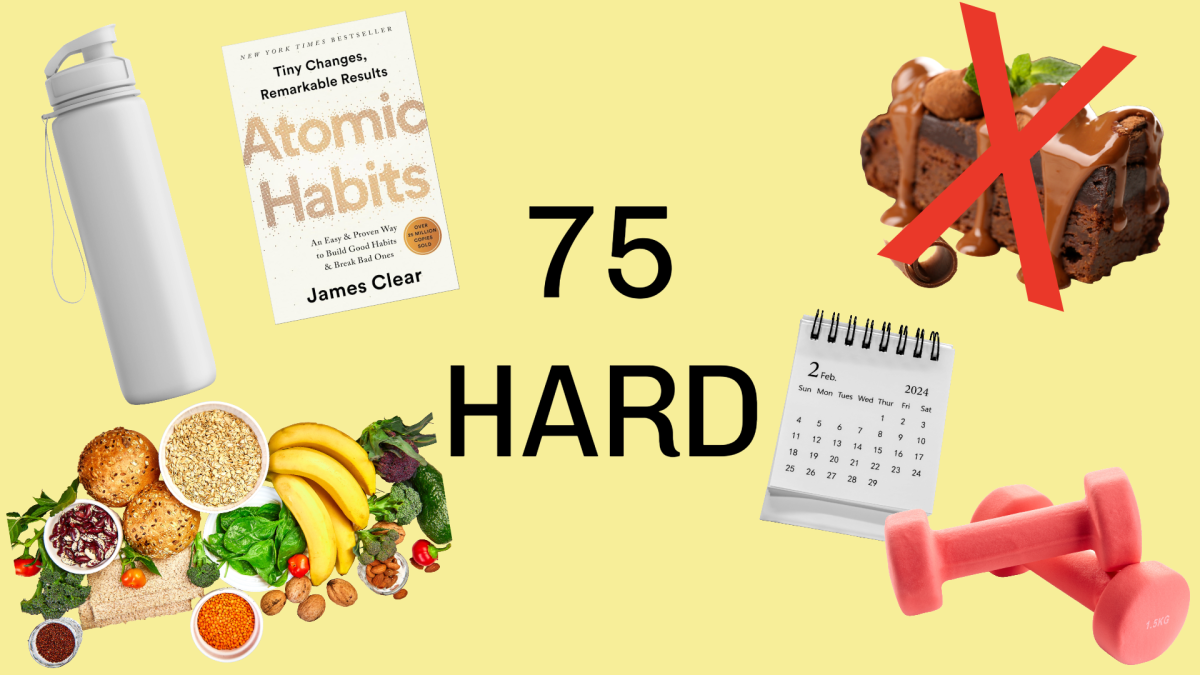
To begin, we need to fully understand what exactly 75 Hard is. Participants in the challenge follow six set requirements every day for 75 days, without rest. These requirements include: two 45-minute workouts. One must be outside. Adhere to a diet of your choice with no cheat meals. Read 10 pages of a self-help or educational book, drink a gallon of water, and take a progress picture. Many fitness enthusiasts put their own spin on the challenge by trading self-help books for Bible studies or adding the requirement of getting a certain number of steps a day. Some have even intensified the challenge. For some, this may already sound a lot like their everyday life, but for others, it is something that could completely transform their lives.
The challenge was created by entrepreneur and motivational speaker, Andy Frisella in 2019. Through social media, the challenge became renowned overnight. Americans’ obsession with constantly wanting to better themselves is another credit to the success of the challenge. It is simple: follow the plan, commit to the challenge, and get fit. Well, it sounds much simpler than it is.
What makes 75 Hard so hard? To begin, it is extremely difficult, unrealistic, and counterproductive. The idea behind 75 Hard is that you are going non-stop for 75 days. No rest. No recovery. This puts extreme pressure and intense strain on your body. “You always need to have some rest days built in,” says Hummer-Bair from The American College of Sports Medicine. “It’s imperative to our bodies. If you’re someone who works out a lot and you’re looking for something extra, I would say go ahead and increase to a sixth day. But I would never recommend more than six days a week for anyone.” Hummer-Bair added. When we work out, we break down our muscles to build them up twice as strong. Without properly refueling your body with the rest it needs, you are depriving it of its ability to grow, recover, and perform to its full potential.
There are some positive aspects that the challenge promotes, such as reading more and increasing your water intake. But, with every positive, there are ten negatives. For example, it is important to have progress photos to show how well you are doing, how far you have come, and to look back on once you have completed your challenge. This may seem positive in theory, but in reality, it could lead to body image issues and obsession with progress. There is a common misconception that weight loss is always a constant upward slope. When in actuality, it fluctuates, there are setbacks, and plateaus. Relying on daily progress pictures only reestablishes this false idea.
Another negative aspect of this challenge is the idea of following a set diet. In my personal opinion, it is absolutely fine to incorporate more nutrient-filled foods into your diet. What is not fine is restricting and limiting your body. The so-called “diet culture” is a huge polarizing topic in the media right now. Many agree, many hate, and several are left in between, not knowing what to believe. The facts are that your body needs proper nutrition to function properly and perform. “Diets imply restriction,” Linder Center of Hope.org states. “Psychologically, dietary restraint can lead to greater reactivity to food cues, increased cravings and disinhibition, and overeating and binge eating. Biologically, dieting can lead to unhealthy changes in body composition, hormonal changes, reduced bone density, menstrual disturbances, and lower resting energy expenditure.” It is also proven that diets can lead to mental health issues, such as eating disorders like anorexia and bulimia. Diets support the idea of fueling to look right, not to feel right. 75 Hard capitalizes on this. It pushes the “all or nothing”, 100% all the time, and no rest, mindsets.
So, after all of this, is 75 Hard right for you? The average completion rate of the challenge is 3%. Only 3% of people were able to complete the challenge, the program. Able to push, fight, and stay consistent. Now, this is not discrediting the thousands of others who tried and fell short. Lewis Cass teacher Mrs. Karmel even rose to the challenge and made it 72 days. She said the best piece of advice she could give someone gutsy enough to participate in the challenge is, “Set attainable goals.” Maybe finding a different approach to the challenge is what will make you part of that three percent. Such as changing to one 45-minute workout a day and one 45-minute walk. Or, you could take weekly progress photos rather than daily. And instead of restricting your food, increase it with more nutritious and healthful foods. Many have even taken it upon themselves to create a new version of the challenge called 75 Soft. This is a much more realistic approach to the challenge.
Whichever you decide to participate in, I hope you remember your true goals, why you started it, and to keep your discipline because motivation will come and go. Even if you do not participate in either one of these, I hope you picked up some healthy habits or pieces of advice you can carry on with you into the rest of your life.